


When something surprises us, hurts us, or changes us, we tend to look for an explanation.
“Why did this happen to me?” “What’s the point?” This need to give shape to experience—to make what we’ve lived through understandable—is at the heart of what Jerome Bruner called acts of meaning.
In his book Acts of Meaning (1990), Bruner criticizes the dominant psychology of his time, the one that viewed the mind as a machine that processes information. For him, that view had left out the most essential element: meaning.
Bruner proposes recovering a more human psychology, one that recognizes that our actions are not understood solely by biological causes or external stimuli, but because they are guided by our intentional states: our beliefs, desires, goals, and values.
And all of this can only be understood within a shared framework: culture.
Thus, the idea of a cultural psychology—or as he calls it, “folk psychology”—is born, which understands the mind as something deeply intertwined with the symbolic world in which we live.
There is no mind without culture, nor meaning without community.

The Stories That Make Us Human
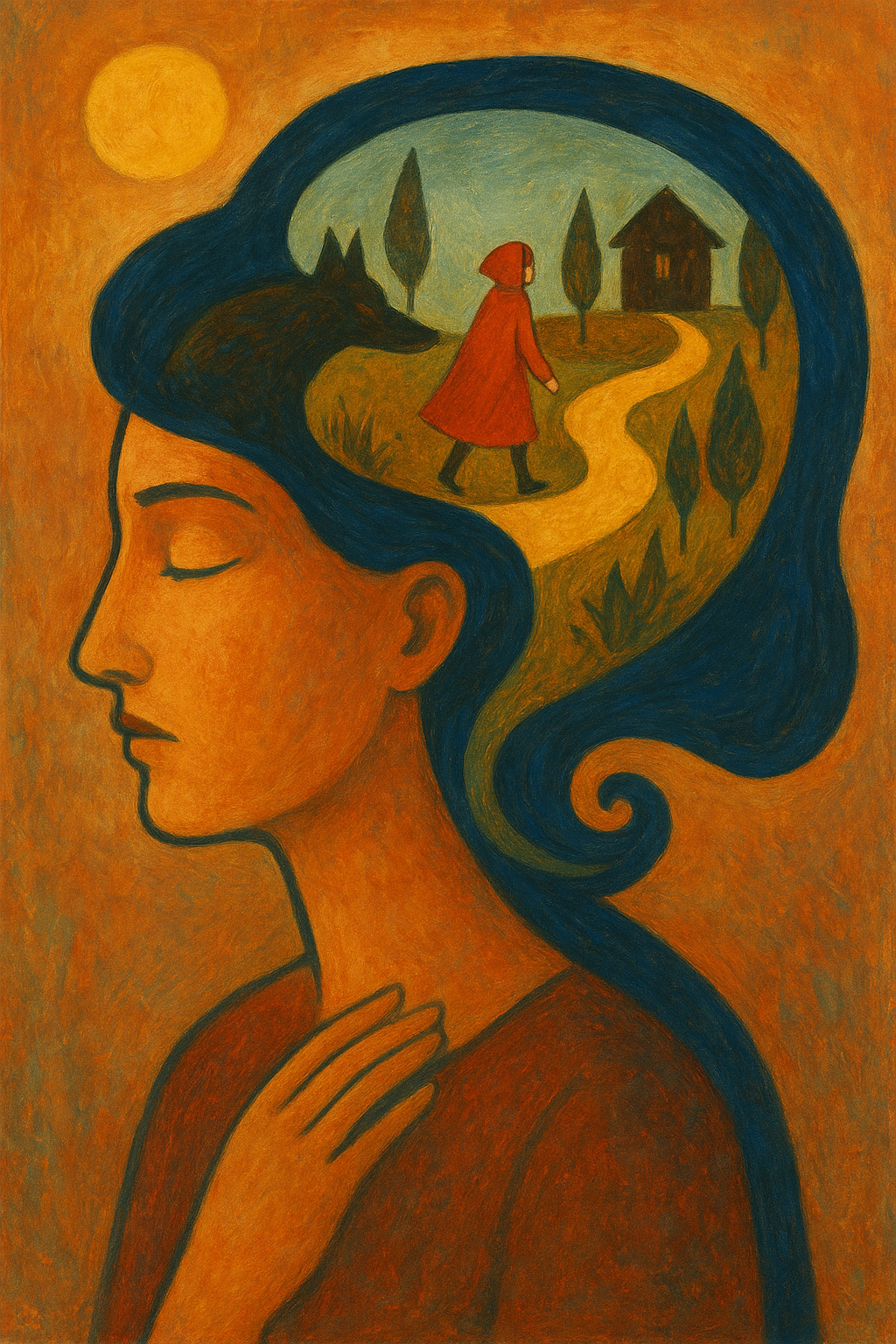
For Bruner, the quintessential cultural instrument is narrative. Through stories, we shape our experience and create meaning amidst chaos.
When something deviates from the expected—a breakup, an illness, a radical change—we need to tell it in order to integrate it into our life story. Narrative allows us to connect the exceptional with the everyday, to reconcile what disrupts the balance with what we know.
In fact, Bruner explains that a good story usually contains a “problem,” something that disrupts the world as we understand it and forces us to seek new meaning. Thus, storytelling is a way of ordering life.
The Self as Narrator: How We Construct Ourselves Through Storytelling
One of Bruner’s most beautiful contributions is his vision of the self as a narrative construct.
There is no fixed “self” within us; we are the result of the stories we tell and the stories others tell about us. Every memory, every project, every relationship is woven into a narrative that gives coherence to who we believe ourselves to be.
That’s why Bruner says the self is “distributed” among people and contexts. We discover ourselves through dialogue, through the gaze of others, through conversations in which we try to explain who we are and what has happened to us.
In therapy, this idea takes on special force: psychological work can be seen as an act of re-narration, a process where the patient explores new ways of telling their story and, therefore, of living.
Bruner also reminds us that meaning is not “inside” words, but in the way we use them.
We learn language—and with it, meaning—by participating in living contexts, in interactions with others, in the fabric of culture. Therefore, human development cannot be understood as the accumulation of knowledge, but as a progressive entry into the world of shared meanings.

An Interpretive Psychology
Ultimately, Acts of Meaning is a passionate defense of a psychology that listens, interprets, and understands that each person inhabits their own symbolic universe.
Bruner reminds us that understanding someone is not about analyzing them, but about interpreting the meaning of their actions within the context that gives them sense.
Because in the end, living—as he himself suggests—is not just existing: it is about narrating our own experiences.