


The Sex Controversy: Women in the 2024 Olympic Games
Predominant Western thought has relied heavily on biology and specifically on sex for its social and identity organization. Its rock, its primary basis, is biology. It considers that there are two sexes at birth based on the observation of genitalia, now on genetics, hormones and chromosomes. This vision is problematic, because many bodies teach us that such a division is not so simple, just look at the controversy that has caused much controversy in social networks these Olympic Games 2024. Accusations of female boxers from Taiwan and Algeria because their hormones are not the right ones to be considered female or because they had the wrong chromosome. What happens when the solid rock of biology fails to determine the sex of people? First, it is not so solid that to fit into the category of woman or man you have to make several forced maneuvers, because there are only two possible conceptions: you are either a man or a woman. It seems that it is so important to fit within these two categories because being outside them there are no referents of what you are – pointing to being – and what you can or cannot do within this society – pointing to your place in the world and its hierarchies.
The debate about what are the appropriate testosterone levels to be considered a woman, how does the XY chromosome interfere in physical performance, what other cells or hormones intervene in people so that these two aspects (testosterone or XY chromosomes) influence their physical performance and, in conclusion, where do we put the barrier of what is considered to be a man or a woman? There is no way out of this dilemma without encountering other problems that science cannot firmly solve, because that rock (not) solid biology leads to contradictions. Once it was the size of the brain, the size of the clitoris or the shape of the skull, now it is hormones, genetics or the chromosome. Why is it so important to know whether one is a man or a woman?
As always, this type of controversy strongly affects the female sex. First, women’s bodies under the spotlight. With the constant suspicion of whether or not they are women, affecting many women who have competed in different sports, their bodies have been the center of hoaxes, criticism and mockery for not complying with the canon of the “feminine” body. Women always live under suspicion and under the scrutiny of how they should look or how they should act to be considered “real women”. Second, invasion of their bodies. They are the ones who must undergo invasive and, as we have seen, public physical tests to verify their sex. All this because testosterone is considered to be a super hormone that gives superpowers to those who carry it, when for women who have a high testosterone level it has certainly not been an advantage. Third, the socio-cultural factor. In sport, women have much more difficulties to reach their maximum performance, because culturally sport has been a male domain: competitiveness, strength, performance, investment of money, lack of experts in women’s sport, lack of social support to devote themselves professionally to sport and the transgression they must constantly make to the place given to them as women in their society is exhausting, and many give up before achieving their goals.
Other views
What happens in other cultures where sex is not the organizing principle of their society? Outside the predominant Western world, other proposals are emerging. Here are two that I find very interesting.
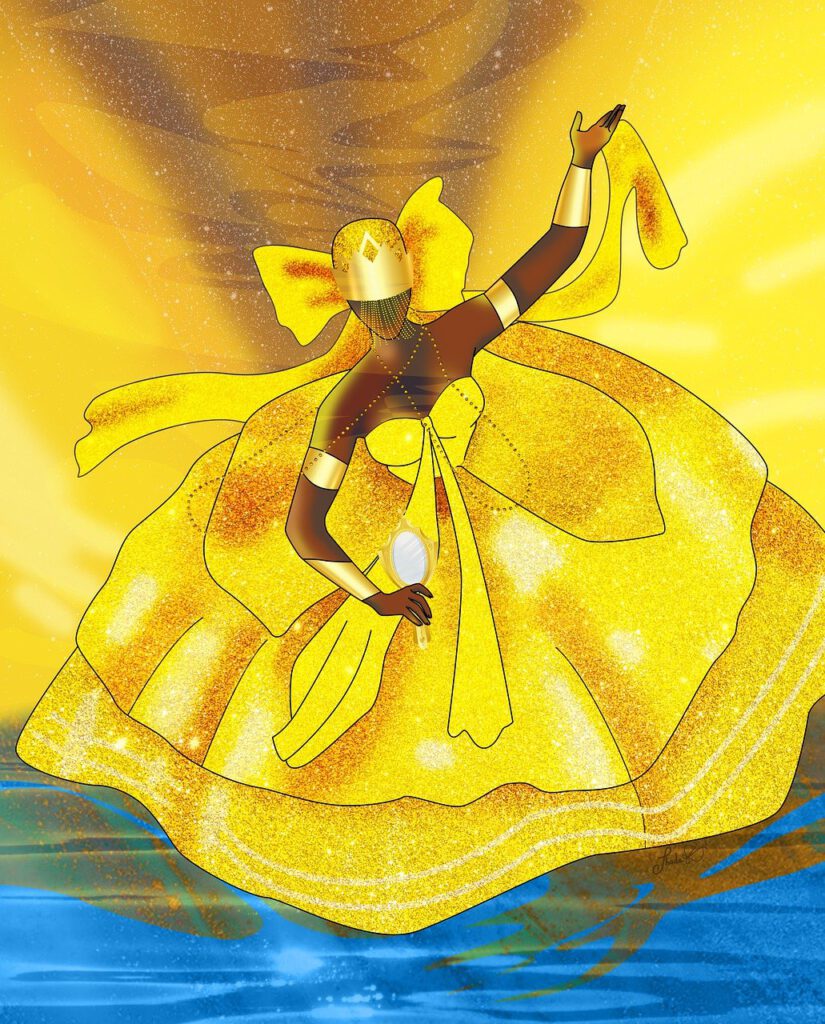
Yorúbá society
Oyéronké Oyéwúmi’s thesis “The Invention of Women” presents us with several arguments that counterpose the centrality of sex as an organizing principle in the West with the centrality of seniority in Yorúbá society. The author, a Nigerian political scientist and sociologist, argues that it is not gender that is socially constructed, but the reference to sex as something primordial that is placed at the center of the social order, this sort of solid rock on which Western culture seeks to rely, is already a social construct:
“But biology is constantly transforming and does not remain unchanging. Basically, the most important point is not that gender is socially constructed, but that to a large extent biology itself is socially constructed and therefore inseparable from the social.
The way in which the conceptual categories of sex and gender function in feminist discourse is based on the assumption that biological and social ideas can be separated and applied universally. Thus, sex is presented as the natural category and gender as the social construction of the natural. But, ultimately, it becomes obvious that even sex has elements of construction.” (p.49-50)
“The cultural logic of Western social categories is based on an ideology of biological determinism: the conviction that biology provides the fundamental reason for the organization of the social world. Thus, as noted above, this cultural logic is in reality a “bio-logic”.“ (p.51)
Biological logic creates a hierarchy based on the supremacy of the masculine, of the male, which in nature – equating a certain ‘animal’ nature of mammals to that of human beings – creates a reading that justifies this hierarchizing framework and reads the world and other social realities under that magnifying glass:
”Gender has indisputably been a fundamental organizing principle in Western societies. In its conceptualization lies intrinsically a dichotomy in which male and female, man and woman are constantly classified in a binary way, both in their relations with and against each other. It has been well documented that in Western social practice the categories of male and female are not free of hierarchical associations and binary oppositions in which male implies privilege and female subordination. It is a duality inherent in the definition of gender based on an appreciation of human sexual dimorphism. Like so many other societies throughout the world, Yoruba society has been analyzed through Western concepts of gender, assuming that it is a gender category. But, as Serge Tcherkézoff warns, “an analysis that begins with the male/female pairing does nothing but promote dichotomies”. It is therefore not surprising that when they look for it, researchers always find gender.
In this context I will demonstrate that prior to Western colonization, gender was not an organizing principle of Yoruba society… If anything, the basic principle of social organization was seniority, defined by relative age. The social categories “woman” and ‘man’ are social constructs derived from the Western assumption that “physical bodies are social bodies”.” (p.83-84).
On the debate that opened the subject of sexuality in the Olympic Games there are some paragraphs that Oyéronké writes that help us to reflect on the subject:
“When it has been said that genes determine behavior and that above all things science is the irrefutable source of wisdom, it is difficult to imagine a postchromosic and posthormonal world in which the acceptance of reproductive roles characteristic of women and men does not lead to the creation of social hierarchies. The challenge posed by Yorúbá conceptions consists of a social world based not on the body but on social relations”. (p. 90).
It is a very interesting text that makes us think and resituate the social structures that depend on the centrality of the construction of biological sex and reveals other forms of social construction that are not based on bio-logic, as expressed by Oyéronké. It makes us imagine other possible scenarios, what would a society that bases its social order on seniority, where roles are interchangeable, where gender does not exist as such, does not define your place in a hierarchy and does not give you a being (individual, biological, within each one)?
The importance of the creation myth: Maya culture
One of the few books that have been preserved from the Maya is the Popol-Vuh, which narrates the myths about the creation of the human being. Aura Cumes, Mayan anthropologist, makes a reading of the original myth:
“If we go to the Adamic myth, it is very evident. A male god created Adam and from his rib came Eve. This patriarchy is supported in the Bible. But within our founding stories, how did women and men come about? According to the Popol Vuj, about eleven couples are self-convened, representing everything that gives life: the heart of the sky and the earth, the rivers and lakes, the small and big animals, the female “deities” and the male “deities”, among others. Everything that already has life is self-convoked to make winak, people, not man. Moreover, the Creators and Shapers is not one, nor is it man, it is all that surrounds us, that which gives us life is plural; the mention of energies is always in pair.”
The myth of the origin of life has always had much importance, for it is in myths that we can find the explanation of the enigmas that confront that society. There is no greater enigma for humanity than its origin, how did life begin?In the myth of the Bible we are given an all-powerful male God who is the only creator of everything, creates man as his equal, gives him the soul and makes him lord and master of everything else (nature and animals). He creates woman from man and never on an equal footing. The creation of man and woman in the Popol Vuh is totally different, it is plural, everything that has life is summoned and they create “people”. The creative energies or deities are pairs, it is not exactly the masculine and the feminine, it can be the pair and lake that are observed complementary, there is not one without the other. It is a necessary pair, complementary, not a hierarchical binary. But they also refer to grandmothers and grandfathers, mother and father, referring to the importance of ancestry. Aura continues:
“It is very evident the idea of the pair in the current rituals, it is always thanked by saying Matiox che k’a tit k’a mam [thanks to our grandmothers-grandfathers], Matiox che k’a te k’a tat [Thanks to our mothers-parents], and women’s energy precedes men’s. It is a completely different sense of life. It is a sense of life completely different from the West. In the creation of life we never find man at the center or alone. The generation of life is in pair, and not always in pair woman and man, it is the other pair nearby: there is the pair lake and river, for example. Creation reflects the “poly”: we are a world founded on the plural.”
Thinking about the plural as an organizing principle, as well as thinking about complementarity outside of the masculine and feminine, a complementarity that is not exclusive but necessary, I believe is very foreign to western culture and difficult to understand, but that allows us to think in horizons very different from our own. In the interview with Aura she says:
“The Popol vuj says that Ixpiyacoc and Ixmucané created the first four men and the first four women, with corn dough ground on the stone. These names have the prefix ix, which is exclusive for women. So far I have seen that all the translators of the Popol vuj think that Ixpiyacoc is man and Ixmucané is woman, because in their description they are named as twice grandmother, twice grandfather, but no; Ixpiyacoc and Ixmucané are highly respected authorities, who had the quality of mother-father and grandmother-grandfather, but both are woman energy.”
“The principle of existence is not the individual, but the pair through which agreements can be created and a life based on poly and pluri can be built. Gender was not a basic organization of the Original Peoples, that comes later” (with colonization).
The debate on gender as an organizing principle of culture
When we get to know other forms of life – so different from the predominant one – their original myths, their organizing principles, their hierarchies or their social organization, it makes us imagine other possible ways of structuring our own reality and makes us wonder about the foundations of our own mythical, social, individual, hierarchical structure. That is to say, it helps us to question the foundations of what we consider absolutely true, immovable and solid. Sometimes the discomfort that we have as people living in this world and that we treat in our psychotherapy, are based on these turning points, where there are immovable and solid truths that do not allow us to move from a point of suffering.